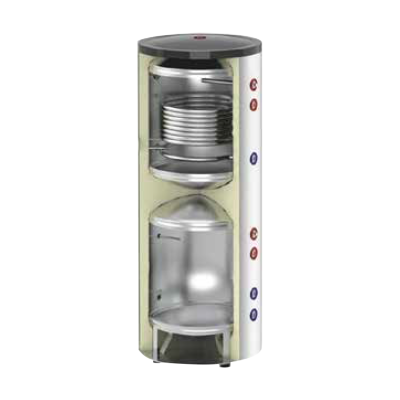
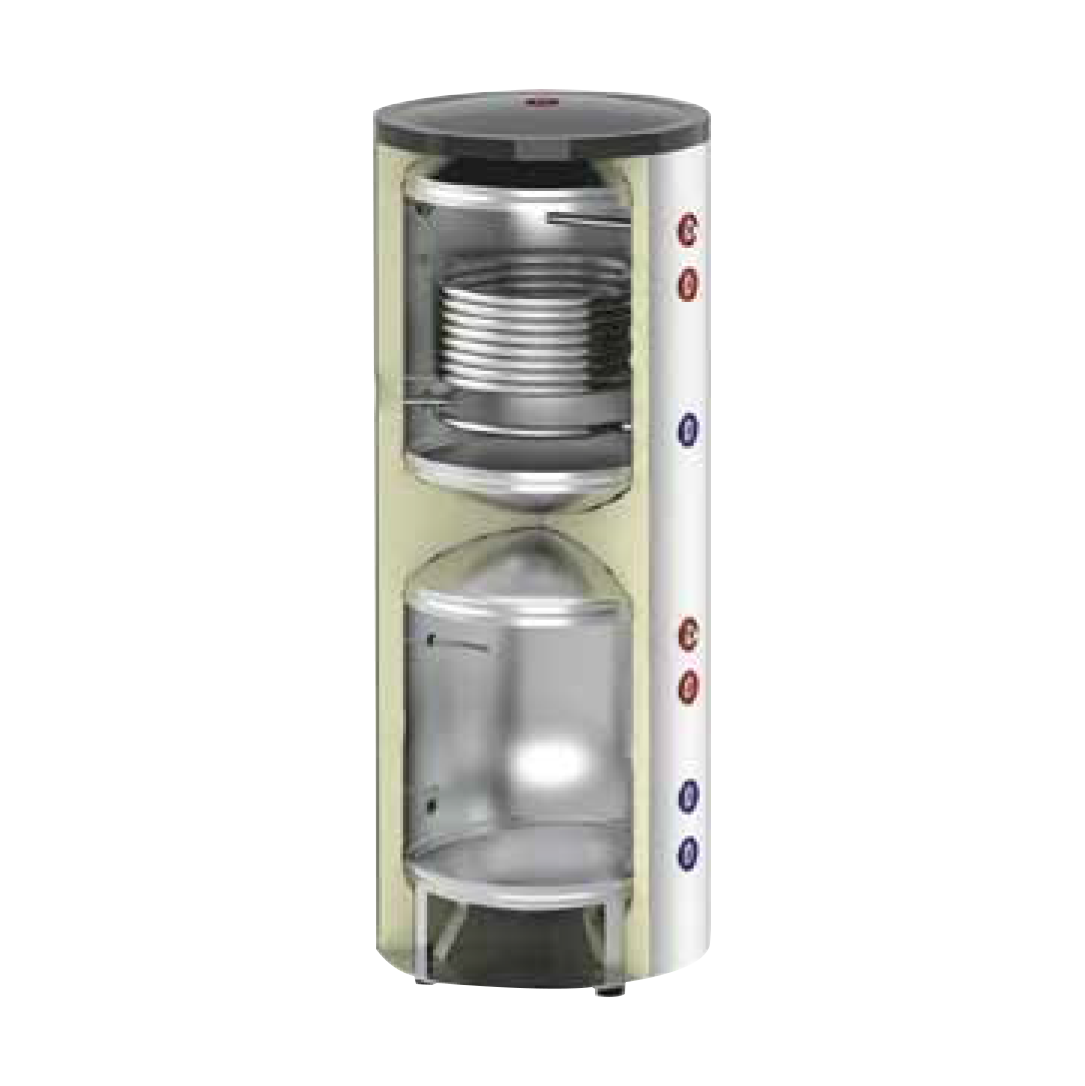
A two-in-one tank, which combines a domestic hot water (DHW) tank and a buffer tank into a single integrated unit, offers multiple advantages by simplifying system design and improving overall efficiency. By merging hot water storage and thermal buffering functions, this solution significantly reduces the space required compared to separate tanks, making it ideal for installations with limited mechanical room space.
At the same time, the DHW section ensures a reliable and consistent supply of domestic hot water. As a result, two-in-one tanks provide a compact, efficient, and reliable solution for modern residential and commercial heating and hot water systems.

24 Hours Hot Water

Energy Saving

Green House

Customization

High-Pressure Water Supply
| Capacity (L) | 100L+50L / 150L+50L / 200L+50L 200L+100L / 300L+200L |
| Inner tank material | SUS304 / SUS316L / Duplex Steel 2205 |
| Outer tank material | Galvanized steel with painting SUS201 / SUS304 / SUS316L |
| Insulation thickness (mm) | 50 standard, optional 45/55/60/80/100 |
| Connection size (inch) | 1/2″ 3/4″ 1″ 5/4″ 6/4″ 2″ |
| Electric heater | 1″- 6/4″ 1.5-3Kw 110-240V 50-60Hz |
| Heat exchange material | Stainless steel/TP2 copper |
1. This is a stainless steel, pressurized, insulated water tank with an operating pressure of 6 bar and a test pressure of 10 bar for 10 minutes.
2. This tank can be used in household and commercial high-volume water applications.
Space-Saving Integrated Design
A Two-in-One Tank combines a domestic hot water (DHW) tank and a buffer tank into a single compact unit. This integrated design eliminates the need for two separate tanks, making it an ideal solution for households with limited mechanical room space or renovation projects where installation space is constrained.
Simplified Installation and Reduced System Complexity
By integrating two functions into one unit, the system requires fewer pipes, valves, and connection points. This simplifies system layout, shortens installation time, and reduces the risk of leakage, heat loss, or control-related issues, resulting in improved overall system reliability.
Improved System Performance and Efficiency
The built-in buffer section stores excess thermal energy and releases it as needed, helping to stabilize heat pump or boiler operation. This reduces frequent start-stop cycling, improves energy efficiency, and extends the service life of the heat source. Meanwhile, the DHW section ensures a consistent and hygienic supply of hot water for everyday household use.
Lower Total System Cost
Using a single combined tank often results in lower total system cost compared to installing two separate tanks. Savings are achieved through reduced installation labor, fewer system components, and improved operational efficiency, delivering long-term economic benefits for homeowners.
Two-in-One Tanks are primarily designed for household applications , particularly in homes that rely on heat pump systems for space heating and hot water production. They are well suited for single-family homes, townhouses, and low-rise residential buildings where both domestic hot water and space heating are required.
These tanks are commonly used in systems such as:
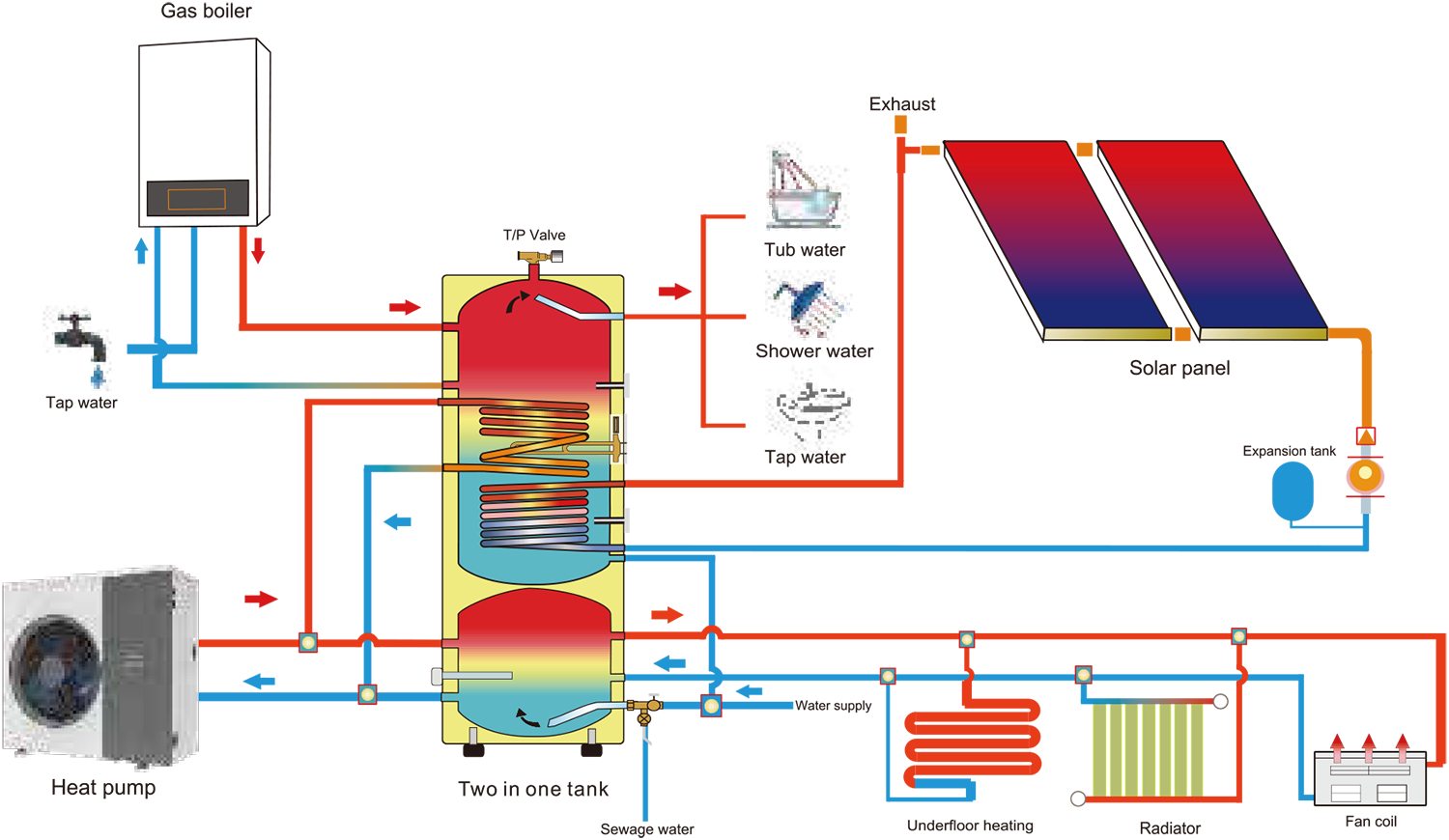
Air-source or ground-source heat pump systems
Underfloor heating systems
Radiator-based heating systems
Hybrid systems combining heat pumps with auxiliary heaters or solar thermal sources
Because of their buffering capability, Two-in-One Tanks are especially beneficial in homes with variable hot water demand or multiple heating zones . The buffer section smooths out load fluctuations, while the DHW section ensures consistent hot water supply for bathrooms, kitchens, and laundry use.
Their compact and integrated design also makes them suitable for energy-efficient and low-energy homes , where system efficiency, space optimization, and clean installation are key design priorities.
Two-in-One Tanks are available in various capacity combinations, typically expressed as DHW volume plus buffer volume . Common configurations may range from smaller household systems to larger setups designed for higher occupancy homes.
When selecting the right size, several factors should be considered:
Number of occupants in the household
Daily hot water consumption , including showers, baths, and appliances
Heating system capacity and operating pattern
Peak demand periods , such as mornings and evenings
For smaller households, a moderate DHW volume combined with a compact buffer section may be sufficient. Larger families or homes with higher hot water usage benefit from increased DHW capacity, while homes with extensive underfloor heating systems may require a larger buffer volume to ensure stable heat pump operation.
Proper sizing ensures consistent hot water availability, efficient heat source operation, and optimal energy performance . Oversizing can lead to unnecessary heat loss and higher initial cost, while undersizing may result in insufficient hot water or reduced system efficiency. Consulting system design guidelines or a heating professional is recommended to achieve the best balance.